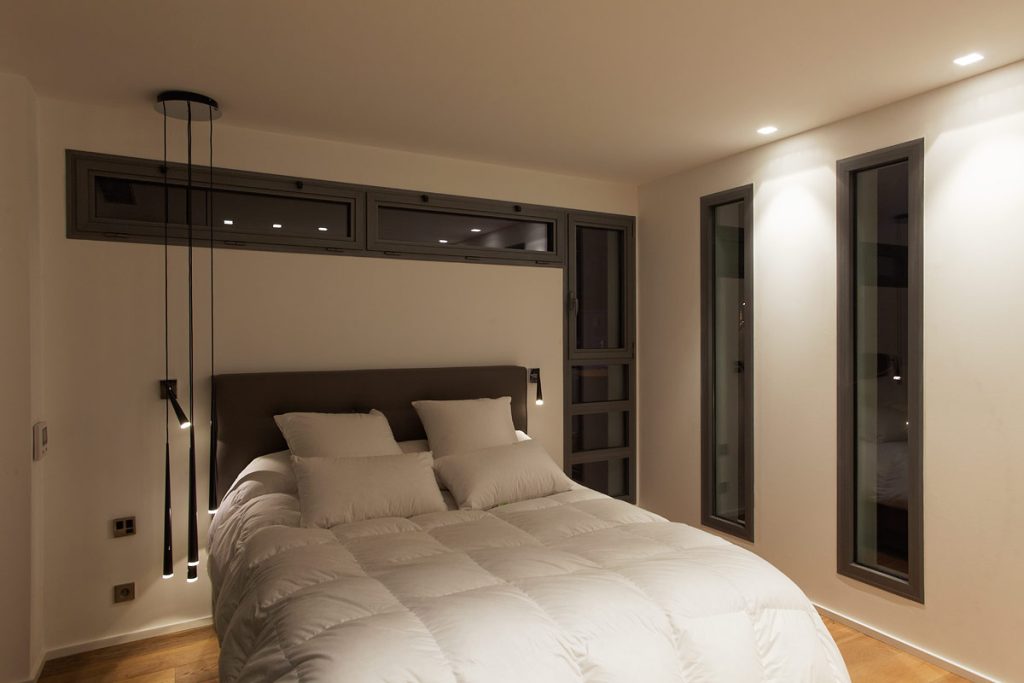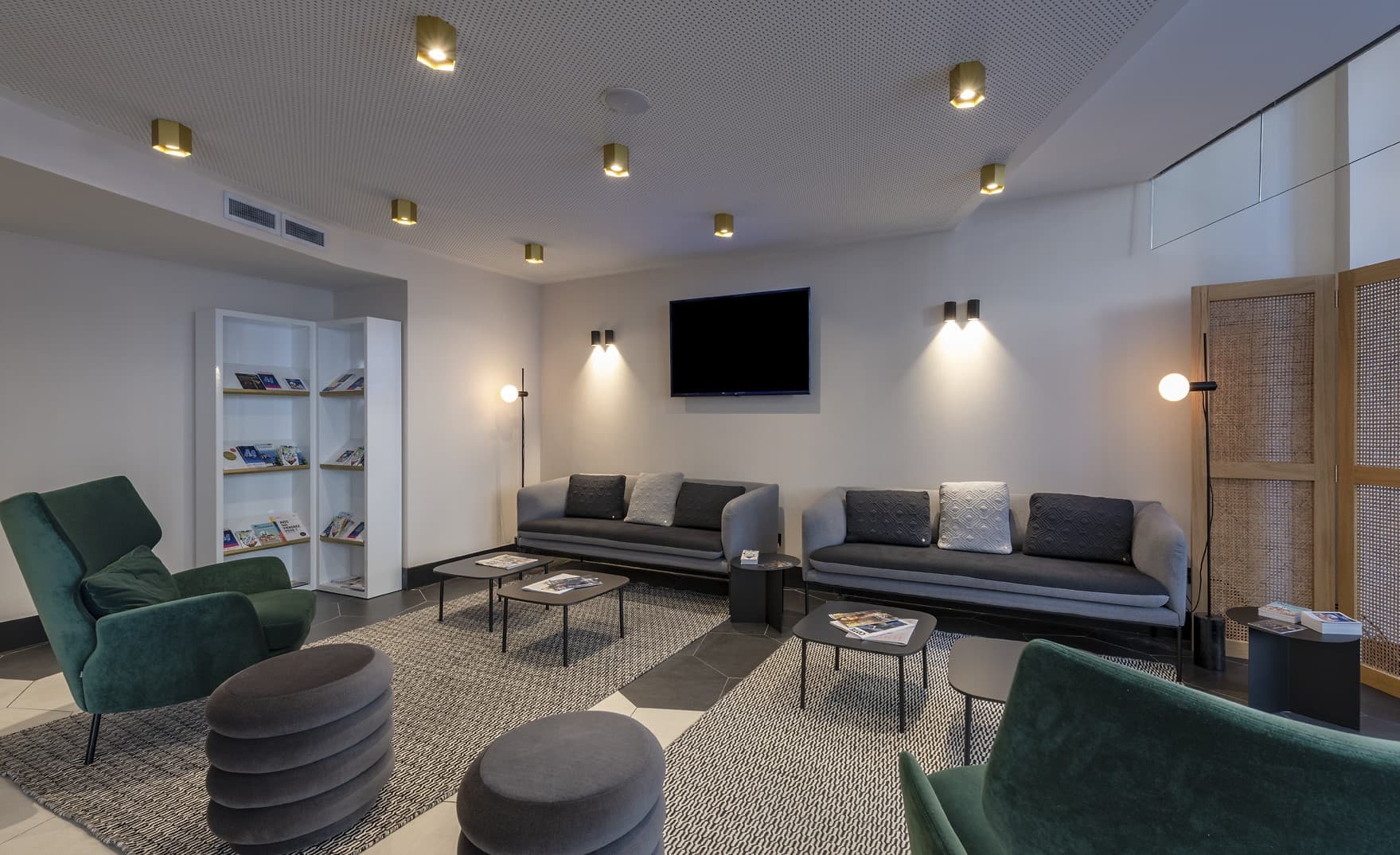
Basic lighting
According to the AFE (Association Française de l'Eclairage) figures:
"The average lighting time in households is 2,464 hours per year, or 6.7 hours per day. Each household has an average of 25 light points and buys 3 lamps per year. "
The importance of lighting is sometimes overlooked, yet light plays an essential role. Indeed, lighting is the basis of interior design, the backbone.
A kitchen that is not sufficiently lit and you run the risk of cutting your finger, a bathroom that is too bright and gives you a scary look.
A lack of light? a dark room? how to make a success of its lighting? what are the elements to take into account? That's what we'll look at in this article.
There are four main points to consider:
1. The choice of bulb
2. The type of lighting
3. The Kelvin light temperature
4. Light intensity, luminous flux (Watts and Lumens)
Choice of bulb
When we have chosen the light fitting that corresponds to our needs and our interior, there is still one essential point: choosing the right bulb to put in.
Faced with the immensity of the choice, we sometimes choose… randomly
Stop the pale bulbs that give a bad complexion and distort your decoration, we work on our lighting!
Here are a few explanations on the basics of light colours and how to choose the right bulb to get the right look.
Among all the bulbs on the market, we find the best known standard bulbs such as E27 and E14
These are bulbs with a screw base and their numbers correspond to the diameter. The size of the bulb is therefore more or less narrow.
The E in E27 or E14 stands for Edison.
Another common type of bulb is the GU10, which has a pin base and an adjustable opening diameter from 25° to 120°. From a narrow, directional light (for a picture frame in an art gallery) to a diffuse light that illuminates the rest of the room.
Say goodbye to the halogen bulb, which heats up and consumes a lot of energy. Go for an LED bulb absolutely! It reproduces all shades of white (warm, neutral and cold), allows you to save up to 80% of energy, it does not heat up and its lighting duration is much longer. Vintage bulbs with visible filaments can also be LED.
The type of lighting
Before making your choice, you should also take into account the type of lighting you want
It is important to know what type of lighting we want in order to choose the right bulb:
General lighting: to light a room as a whole
Functional lighting: to light a fixture for a specific task such as cooking, applying make-up, reading or working
Ambient lighting: to light a luminaire with a decorative function
Knowing the type of lighting will therefore enable you to define the appropriate Kelvins.
Kelvin light temperature
The Kelvin is the International System (SI) unit of thermodynamic temperature, symbol K.
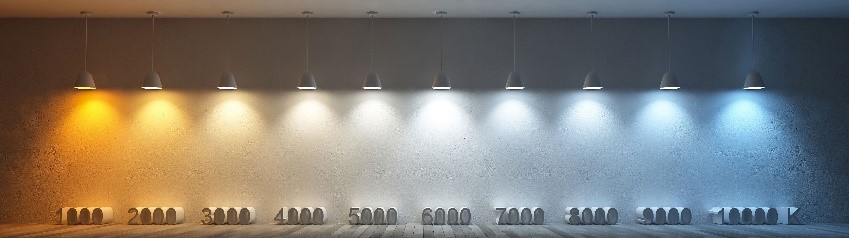
The Kelvin index is like the sun: when the Kelvin index is low on the horizon, it produces a warm white light that is quite encompassing and warm.
So the lower the index, the closer you are to ambient lighting (approx. 2800K)
If the Kelvin index rises in the sky and increases, we arrive at values of 4500k and we will be dealing with a neutral white which is called daylight because it faithfully reproduces colours. This is interesting for the lighting of a kitchen, a dressing room or an office.
If you increase the kelvin index even further, you will end up with a cold white, which should be used sparingly because it is not very good for the retina, but it is still interesting for lighting corridors or bathrooms etc.
Light intensity, luminous flux
The last thing to consider is the light intensity, luminous flux Watts and Lumens
To get an idea of the lighting capacity of a bulb, we often tend to look at the number of watts on the packaging.
The wattage indicates the power consumption of the lamp. The higher the value on the label, the more energy the bulb consumes. The wattage is therefore no longer a sufficient criterion for measuring LED performance.
The number of watts of an LED lamp is lower than that of a conventional lamp. This is because LED lighting uses less energy to provide the same luminous flux as an incandescent bulb.
The lumen refers to the luminous intensity of a bulb, i.e. the quantity of light it generates. This is the capacity of the lamp to illuminate a space. The higher the value on the label, the brighter the light from the bulb.
The lumen is nowadays a decisive criterion in the choice of LED lighting.
Not all bulbs with the same electrical power provide the same luminous flux.
For a soft atmosphere it is recommended to have between 500-600lm
For a more powerful light: 1000 to 1500lm
Finally for a very powerful light 1600lm or even more if it is to light a main room or when the ceiling is very high.
Be careful if a luminaire has several bulbs the lumens are added together, so be careful not to oversize the lighting in your room.
Our advice:
Vary the types of lighting in the room and make the light have different levels, not all at eye level.
We apply this technique to make the volumes not seem flat, to bring a warm side, a more ambient and natural light and to highlight the furniture.